
Kali: The Goddess of Truth
Kali: The Goddess of Truth
The goddess Kali is usually seen at first glance as terrifying and bloodthirsty. Her imagery is shocking, her energy is unsettling, and her symbolism reaches into places where most people prefer not to look. And that is exactly why she deserves our attention, because Kali carries within her one of the deepest spiritual principles that the Hindu tradition has ever expressed: the principle of radical truth that sets free everything it touches.
Who is Kali
Her name comes from the Sanskrit root kāla, which means time. Kali is therefore literally the one who rules over time, and with it, over the end of everything that is bound by time. In Hindu cosmology, she serves as the destroyer of illusions, and in a very specific sense: she arrives wherever too much that is false, vague, and shallow has built up, and she removes it through her presence. Her weapon is truth. Pure, uncompromising, relentless truth, which at its core comes from love, because only truth can truly set a person free.
According to one of the most well-known stories from the text Devi Mahatmya, Kali was born directly from the forehead of the goddess Durga during a fierce battle with the demon Raktabija, who had the ability to multiply from every drop of his own blood that fell to the ground. None of the gods could defeat him, because every strike created a new demon. Kali solved this situation in a radical way: she swallowed the demons whole and drank their blood before it could touch the ground. She destroyed what had seemed indestructible.
This story works as a precise analogy for inner processes. Raktabija represents patterns, beliefs, and lies that constantly replicate within the human psyche, and the more a person tries to fight them with ordinary means, the more of them appear. Every compromise with untruth creates more untruth. Kali symbolises a level of consciousness that can absorb these patterns at their root, because she comes with the only possible weapon: with truth so absolute that only what is real can survive beside it.
What her image tells us
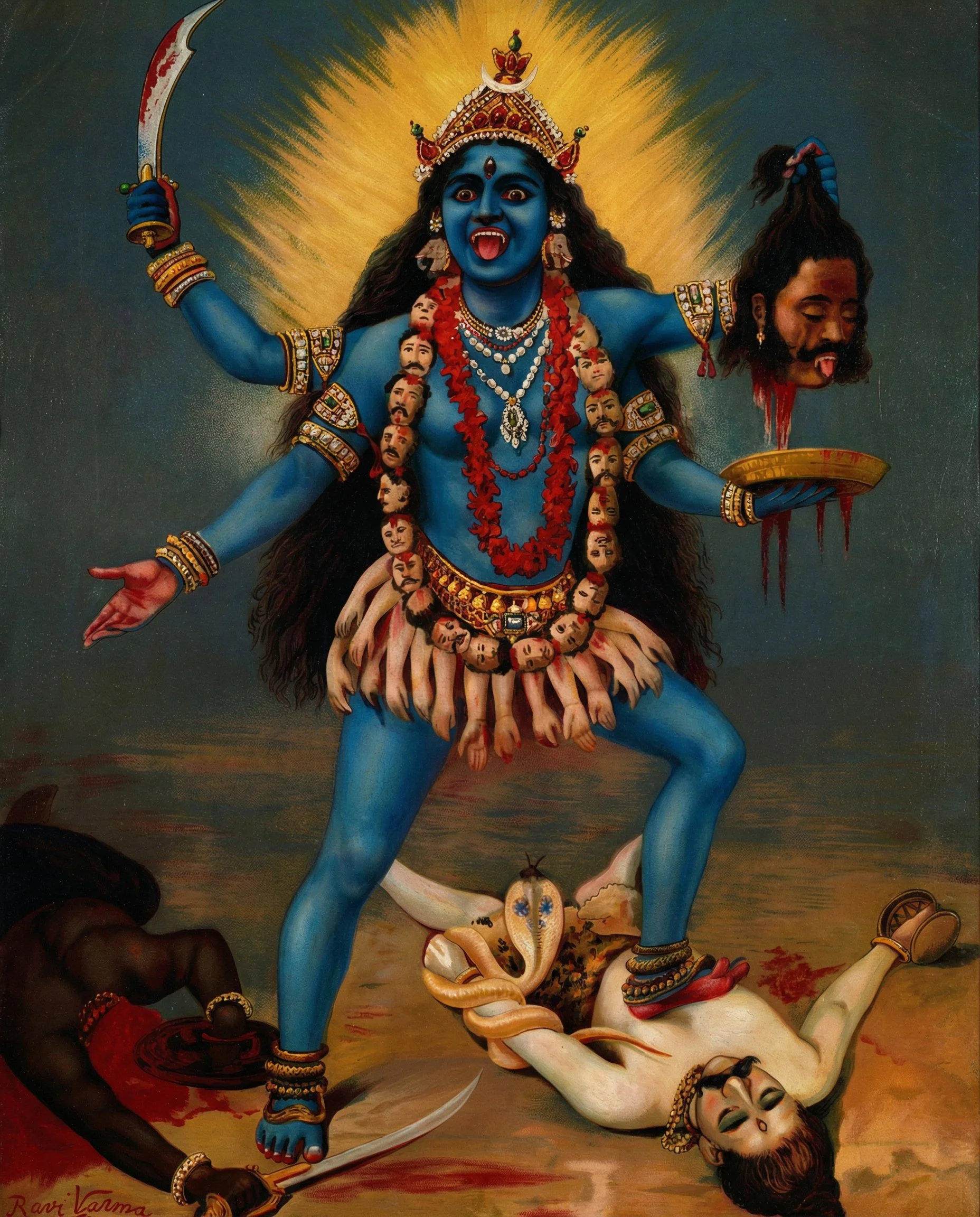
One of the most iconic paintings of Kali comes from the Indian artist Ravi Varma, who lived in the 19th century and became known for depicting Hindu deities in an oil painting tradition influenced by European academicism. His portrayal of Kali became one of the most widely recognised images of this goddess. Every single element in this painting carries a specific symbolic meaning.
The blue colour of her skin refers to infinity and timelessness, because blue in Hindu iconography represents what goes beyond the material world, much like the sky or the ocean have no visible boundaries. Through her colour, Kali expresses that the truth she brings exists outside of space and time, and that it cannot be limited by any human concept.
The halo around her head represents divine radiance and spiritual power. It is a visual expression of pure transformational energy that flows through everything Kali touches, and that burns away everything false with its light, the way the sun burns away fog.
The sword she holds in one of her hands is a tool of discernment. In spiritual tradition, this sword is called the sword of knowledge, and its function is to separate truth from illusion, essence from appearance. It is the same sword that is needed to cut through all lies, pretence, and self-deception.
The severed head symbolises the ego, that part of the human psyche which identifies itself with thoughts, roles, and personal stories. Kali holds it with ease, because the ego, although it presents itself as our entire world, is in reality just a construct that dissolves in the light of truth.
The garland of heads around her neck represents the fifty letters of the Sanskrit alphabet, and therefore the entire range of human knowledge and experience. Kali wears all knowledge as decoration, which suggests that she stands above any conceptual framework, above every theory, above every belief.
The skirt made of severed arms represents liberation from karma, meaning from the consequences of actions. The arms symbolise action, activity, and attachment to results, and their removal means overcoming this cycle, the end of compulsive behaviour driven by fear.
The figure of the god Shiva, on whom Kali stands, is one of the most commonly misunderstood elements of the entire image. Shiva lies motionless here because he represents pure consciousness without expression. Kali as Shakti is the dynamic force that activates this consciousness. Without Shakti, Shiva is literally shava, a lifeless body. Their relationship expresses a fundamental principle: consciousness and energy are inseparable, and one cannot exist without the other. Truth without strength remains just a concept, strength without truth becomes destruction.
The extended tongue has several interpretations in tradition. One of them says that in the heat of destroying illusions, Kali realised she was standing on her own husband and stuck out her tongue as an expression of surprise. This detail brings an element of balance into an otherwise intense image, and reminds us that even the most powerful force carries within it humility and awareness of its own limits.
Kali as a principle of radical truth
Kali in Hindu tradition never represented destruction as such. Her entire essence lies in the fact that she removes and destroys exclusively what is false, outdated, shallow, and dysfunctional. She arrives wherever a person has been hiding for too long behind masks, behind compromises, behind comfortable lies about themselves, about their relationships, and about their life. And she brings with her only one thing: truth.
The truth that Kali carries tends to be painful, shocking, and rejected at first, precisely because it reveals the gap between how a person lives and who they actually are. But everyone who has been through this process knows that after the initial shock comes enormous relief. Because maintaining illusions costs a huge amount of energy. Living in alignment with truth, on the other hand, costs no energy at all. Truth lifts up, frees, and heals everyone and everything.
Integration of Kali in the life of today's woman
For women today, this process of integration has a specific form, because most women were systematically taught from childhood to suppress exactly those qualities that Kali embodies: directness, decisiveness, anger as a healthy response to violated boundaries, and the ability to say a clear and final "enough" without the need to apologise or explain.
Integration of Kali on a psychological level means that a woman stops playing the role that her surroundings, partner, family, or society expect from her. It means stopping everything she does not want. To stop agreeing. To stop helping. To stop staying silent. To stop rescuing. To stop making herself smaller. To stop caretaking. To stop accommodating. To stop hiding. To stop maintaining.
This integration requires courage, because the moment a woman speaks her truth out loud for the first time, she will find that some relationships will not survive it. She will find that some people were with her only because she was convenient and useful to them. She will find that the image she had been building about herself for years will start to fall apart. And that is precisely where the liberation that Kali brings lies: everything that falls apart under the weight of truth was never real.
On a spiritual level, integration of Kali means accepting that transformation happens through the death of what is old. Every shift in consciousness carries with it the death of a previous identity, previous beliefs, and previous certainties. Kali shows that this death is sacred, because it opens space for what is authentic, strong, and alive.
In life, this shows up as the ability to go through a moment of crisis, to look at the painful places of one's own history, to name them, and to move on. As the willingness to leave a relationship that has become deadening, a job that suffocates, or a belief that keeps a person small. As a deep understanding that truth, in whatever form it arrives, is always an act of love and freedom.
Kali stands within every woman who has decided to live her life on her own terms. She stands within every woman who one day stopped asking for permission to be herself, because she understood that she never needed that permission in the first place.
Kálí: bohyně pravdy
Bohyně Kálí bývá na první pohled vnímána jako děsivá a krvežíznivá. Její zobrazení šokuje, její energie znepokojuje a její symbolika sahá do míst, kam se většina lidí raději nedívá. A právě proto stojí za to podívat se na ni pozorně, protože Kálí v sobě nese jeden z nejhlubších duchovních principů, jaký hinduistická tradice kdy formulovala: princip radikální pravdy, která osvobozuje vše, čeho se dotkne.
Kdo je Kálí
Její jméno pochází ze sanskrtského kořene kāla, což znamená čas. Kálí je tedy doslova ta, která vládne času, a tím pádem i zániku všeho, co je časem podmíněné. V hinduistické kosmologii zastává roli ničitelky iluzí, a to ve velmi konkrétním smyslu: přichází tam, kde se nahromadilo příliš mnoho falešného, vágního a povrchního, a svou přítomností to odstraňuje. Její zbraní je pravda. Čistá, nekompromisní, nelítostná pravda, která ale ve svém jádru vychází z lásky, protože jen pravda dokáže člověka skutečně osvobodit.
Podle jednoho z nejznámějších příběhů z textu Déví Máhátmja se Kálí zrodila přímo z čela bohyně Durgy v okamžiku zuřivé bitvy s démonem Raktabídžou, který měl schopnost rozmnožovat se z každé kapky vlastní krve dopadlé na zem. Žádný z bohů si s ním nedokázal poradit, protože každý úder plodil nového démona. Kálí vyřešila tuto situaci radikálně: démony pohlcovala celé a jejich krev vypíjela dříve, než stačila dopadnout na zem. Zničila tak to, co se zdálo být nezničitelné.
Tento příběh funguje jako přesná analogie vnitřních procesů. Raktabídža představuje vzorce, přesvědčení a lži, které se v lidské psychice neustále replikují, a čím více se s nimi člověk snaží bojovat běžnými prostředky, tím více jich vzniká. Každý kompromis s nepravdou plodí další nepravdu. Kálí symbolizuje takovou úroveň vědomí, která tyto vzorce dokáže pohltit v jejich kořeni, protože přichází s jedinou možnou zbraní: s pravdou tak absolutní, že vedle ní přežije pouze to, co je skutečné.
Co říká její zobrazení
Jeden z nejikoničtějších obrazů Kálí pochází od indického malíře Ravi Varmy, který žil v 19. století a proslul tím, že hinduistická božstva zachycoval v olejomalební tradici ovlivněné evropským akademismem. Právě jeho pojetí Kálí se stalo jedním z nejrozšířenějších zobrazení této bohyně. Každý jednotlivý prvek na tomto obraze nese konkrétní symbolický význam.
Modrá barva pleti odkazuje na nekonečnost a bezčasovost, protože modrá v hinduistické ikonografii reprezentuje to, co přesahuje hmotný svět, podobně jako nebe nebo oceán nemají viditelné hranice. Kálí tak svou barvou vyjadřuje, že pravda, kterou přináší, existuje mimo prostor a čas, a že ji nelze ohraničit žádným lidským konceptem.
Svatozář kolem její hlavy představuje božskou záři a duchovní moc. Je to vizuální vyjádření čisté transformační energie, která prostupuje vším, čeho se Kálí dotýká, a která vše falešné spaluje svým světlem tak, jako slunce spaluje mlhu.
Meč, který drží v jedné z rukou, je nástrojem rozlišování. V duchovní tradici se tento meč nazývá meč poznání a jeho funkcí je oddělovat pravdu od iluze, podstatu od přeludu. Je to tentýž meč, který je potřeba k tomu, aby člověk přeřízl všechnu lež, faleš a přetvářku.
Uťatá hlava symbolizuje ego, tedy tu složku lidské psychiky, která se ztotožňuje s myšlenkami, rolemi a příběhy o sobě samém. Kálí ji drží s lehkostí, protože ego, ačkoli se tváří jako celý náš svět, je ve skutečnosti jen konstrukt, který se ve světle pravdy rozpustí.
Girlanda z hlav kolem jejího krku reprezentuje padesát písmen sanskrtské abecedy a tím pádem celý rozsah lidského poznání a zkušenosti. Kálí na sobě nese veškeré vědění jako ozdobu, což naznačuje, že stojí nad jakýmkoli konceptuálním rámcem, nad každou teorií, nad každým přesvědčením.
Suknice z uťatých paží představuje osvobození od karmy, tedy od důsledků činů. Paže symbolizují jednání, aktivitu a připoutanost k výsledkům, a jejich oddělení znamená překonání tohoto cyklu, konec nutkavého jednání motivovaného strachem.
Postava boha Šivy, na které Kálí stojí, patří k nejčastěji nepochopeným prvkům celého zobrazení. Šiva zde leží nehybně, protože představuje čisté vědomí bez projevu. Kálí jako Šakti je dynamickou silou, která toto vědomí aktivuje. Bez Šakti je Šiva doslova šava, tedy mrtvé tělo. Jejich vztah vyjadřuje základní princip: vědomí a energie jsou neoddělitelné a jedno bez druhého nemůže existovat. Pravda bez síly zůstane jen konceptem, síla bez pravdy se stane destrukcí.
Vyplazený jazyk má v tradici několik výkladů. Jeden z nich říká, že v zápalu ničení iluzí si Kálí uvědomila, že šlape po svém vlastním manželovi, a jazyk vyplazila jako výraz překvapení. Tento detail vnáší do jinak intenzivního zobrazení prvek rovnováhy, a připomíná, že i ta nejmocnější síla v sobě nese pokoru a vědomí vlastních hranic.
Kálí jako princip radikální pravdy
Kálí v hinduistické tradici nikdy nepředstavovala destrukci jako takovou. Její celá podstata spočívá v tom, že odstraňuje a ničí výhradně to, co je falešné, zastaralé, mělké a nefunkční. Přichází tam, kde se člověk příliš dlouho ukrýval za masky, za kompromisy, za pohodlné lži o sobě, o svých vztazích a o svém životě. A přináší s sebou jedinou věc: pravdu.
Pravda, kterou Kálí nese, bývá zpočátku bolestivá, šokující a odmítaná, přesně proto, že odhaluje rozpor mezi tím, jak člověk žije, a tím, kým ve skutečnosti je. Ale každý, kdo tímto procesem prošel, ví, že po počátečním šoku přichází obrovská úleva. Protože udržovat iluze stojí obrovské množství energie. Žít v souladu s pravdou naopak žádnou energii nestojí. Pravda pozvedá, osvobozuje a léčí všechny a všechno.
Integrace Kálí v životě dnešní ženy
Pro ženy dnešní doby má tento proces integrace specifickou podobu, protože většina žen byla od dětství systematicky vedena k tomu, aby potlačovala přesně ty vlastnosti, které Kálí ztělesňuje: přímočarost, rozhodnost, hněv jako zdravou reakci na porušení hranic a schopnost říci jasné a konečné „dost" bez potřeby se omlouvat nebo vysvětlovat.
Integrace Kálí na psychologické rovině znamená, že žena přestane hrát roli, kterou od ní očekává okolí, partner, rodina nebo společnost. Znamená to přestat se vším, co nechce. Přestat souhlasit. Přestat pomáhat. Přestat mlčet. Přestat zachraňovat. Přestat se zmenšovat. Přestat opečovávat. Přestat vyhovovat. Přestat se schovávat. Přestat udržovat.
Tato integrace vyžaduje odvahu, protože v okamžiku, kdy žena poprvé řekne svou pravdu nahlas, zjistí, že některé vztahy to nepřežijí. Zjistí, že někteří lidé s ní byli pouze proto, že pro ně byla pohodlná a výhodná. Zjistí, že obraz, který o sobě léta budovala, se začne rozpadat. A právě v tom spočívá osvobození, které Kálí přináší: vše, co se rozpadne pod tíhou pravdy, nikdy nebylo skutečné.
Na duchovní rovině integrace Kálí znamená přijetí toho, že transformace probíhá skrze zánik starého. Každý posun ve vědomí s sebou nese smrt předchozí identity, předchozích přesvědčení a předchozích jistot. Kálí ukazuje, že tato smrt je posvátná, protože uvolňuje prostor pro to, co je autentické, silné a živé.
Kálí stojí v každé ženě, která se rozhodla žít svůj život na svých vlastních podmínkách. Stojí v každé ženě, která jednoho dne přestala žádat o svolení být sama sebou, protože pochopila, že toto svolení nikdy nepotřebovala.
